

RSP China Architect Philosophy
To RSP China Architect and Director Bertrand Lai, aged 43, architecture is not just a profession: it is a lifestyle.
In this exclusive interview with an architect at RSP, Bertrand Lai shares insights into his experience at RSP China, his teaching role at RMIT, and his design philosophy that has shaped his impressive portfolio.
He elaborates further that in history, architects such as Da Vinci and Michelangelo called themselves renaissance men, where they dabbled in a lot of creative pursuits beyond just architecture, like sculpture and visual art. He shook his head when asked if he considered himself as such.
“There’s always a pursuit of excellence. As architects, I think it’s very fulfilling that every project we do gives an opportunity to become a better architect, or to be the best,” he shares.

Before becoming an RSP China Architect
His architecture journey began as an undergraduate at the Royal Melbourne Institute of Technology (RMIT), during which he interned at the Singapore office during the summer holidays. After graduating, he taught at RMIT in the first semester from February to July, while working as an architect for the China office for the rest of the year.
“It was a bit tiring but at the same time, I guess it’s invigorating,” Bertrand reminisces. “But then the Chinese projects started to pick up and I felt that I wanted to be here on a more permanent basis. I gave up the teaching job in Australia and the rest is history.”

Architecture is hope
Bertrand’s epiphany to pursue architecture came from his trip to France to attend his brother’s graduation. He recounts wandering through the streets and admiring the architecture, which features Baroque and Gothic style buildings and cathedrals. That experience convinced him to switch courses, and he has not looked back since.
Today, he believes that architecture is hope.
“It’s an optimistic thing,” he says. “We’re trying to give our occupants a better experience, a moment of pause to say, ‘Hey, that’s a nice space, or that’s a nice building.’”
His work
As an example, he recalls his work on the Dareway Software Campus project, a site with five buildings connected by a courtyard. This courtyard, in his words, is a “central element that binds these buildings together, which creates a sense of community.”
A similar connective space can be found underground, which is a second garden of sorts. People can walk through the space during wintertime without taking off their jackets.
“I guess that’s one way design can help the office environment,” Bertrand adds on. “I think good designs allow for better interactivity of its users, to show how people can use the space in a way that enriches their experience. At the end of the day, that’s what good architecture can allow.”

Teaching work at RMIT
As Bertrand admits, he is not certified when he taught at RMIT as a lecturer. “I was just thrown into that environment by my alma-meter,” he recalls.
He explains that RMIT adopts a ‘practice through research’ philosophy, where they recruit working professionals as their faculty. The rationale was that faculty would enhance their own research in their chosen specialty while teaching.
“You sort of learn more than you teach. Students have a lot of fresh ideas,” Bertrand explains. “Since I was in charge of the first-year module, I get a lot of very fresh-eye takes and very interesting approaches to design issues.”
A formative moment
In that vein, he recalls a moment of inspiration during his student years at RMIT. He recalls something impactful a lecturer told him.
“He asked us, ‘What would architects know if they only knew architecture?’ Only when we arm ourselves with knowledge about the world beyond architecture, could we become better storytellers and design buildings that have meaning. Architecture is more than just a building—it has storytelling and culture behind it.”
Language Matters
Bertrand cites the “language” as the biggest challenge while trying to adjust during his architecture journey at RSP China.
“It’s not just about the spoken word and the written one,” Bertrand claims. “We’re talking about design language. It’s about what local clients are used to seeing and their palette.”
Historically, the English language is derived from Latin, where words are constructed with letters. In contrast, the Chinese language is symbol-based, where each unique character represents something. For example, the shape of the Chinese character to refer to fire (火) vaguely resembles fire.
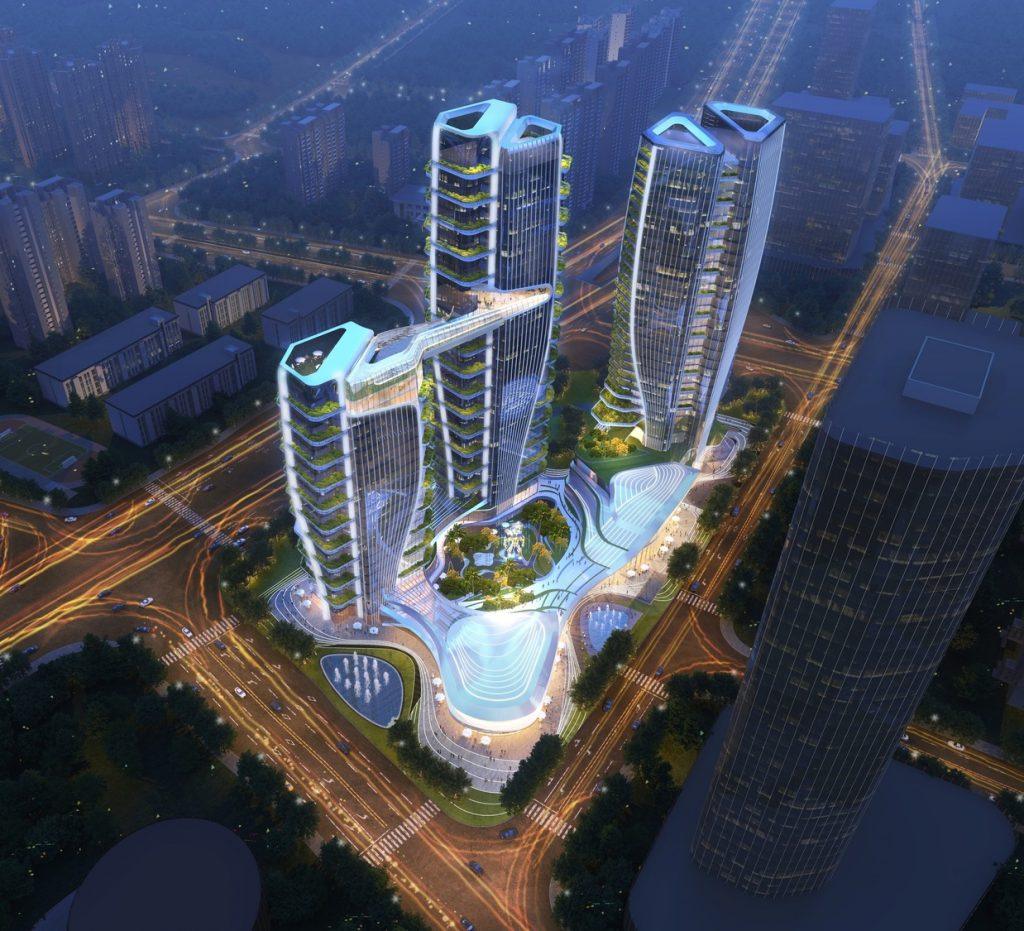
As such, he understands that his Chinese clients generally prefer their narratives to be told through symbols. For example, a mixed-use project in Fuzhou done by RSP China architects comprises of three towers inspired by the jasmine flower, the area’s cultural flower. When seen from above, the towers resemble flower petals dancing in the sky.
Another project he is excited to share is the adaptive reuse of one of Tianjin’s oldest malls: the Quanyechang mall.

Grounding the Future in the Local
Built in 1948, it comprises of two structures, a six-storey mall attached to a ten-storey one, producing a gorgeous historical facade. The work involves uplifting this facade, alongside transforming the interior into a shopping mall. He describes it as a combination of Harrods in London and the Gallery Lafayette in Paris.
Architecture driven by storytelling, context and narrative is more than just an aesthetic preference. In Bertrand’s view, the need for symbolism reflects a consideration and respect for the people these buildings are designed for.
In his words, “On the local aspect here, the way people write and understand the world, the making of words or the making of architecture, is rooted in language. We must understand that clearly when we design for a certain context or culture.”